Unmatched resources
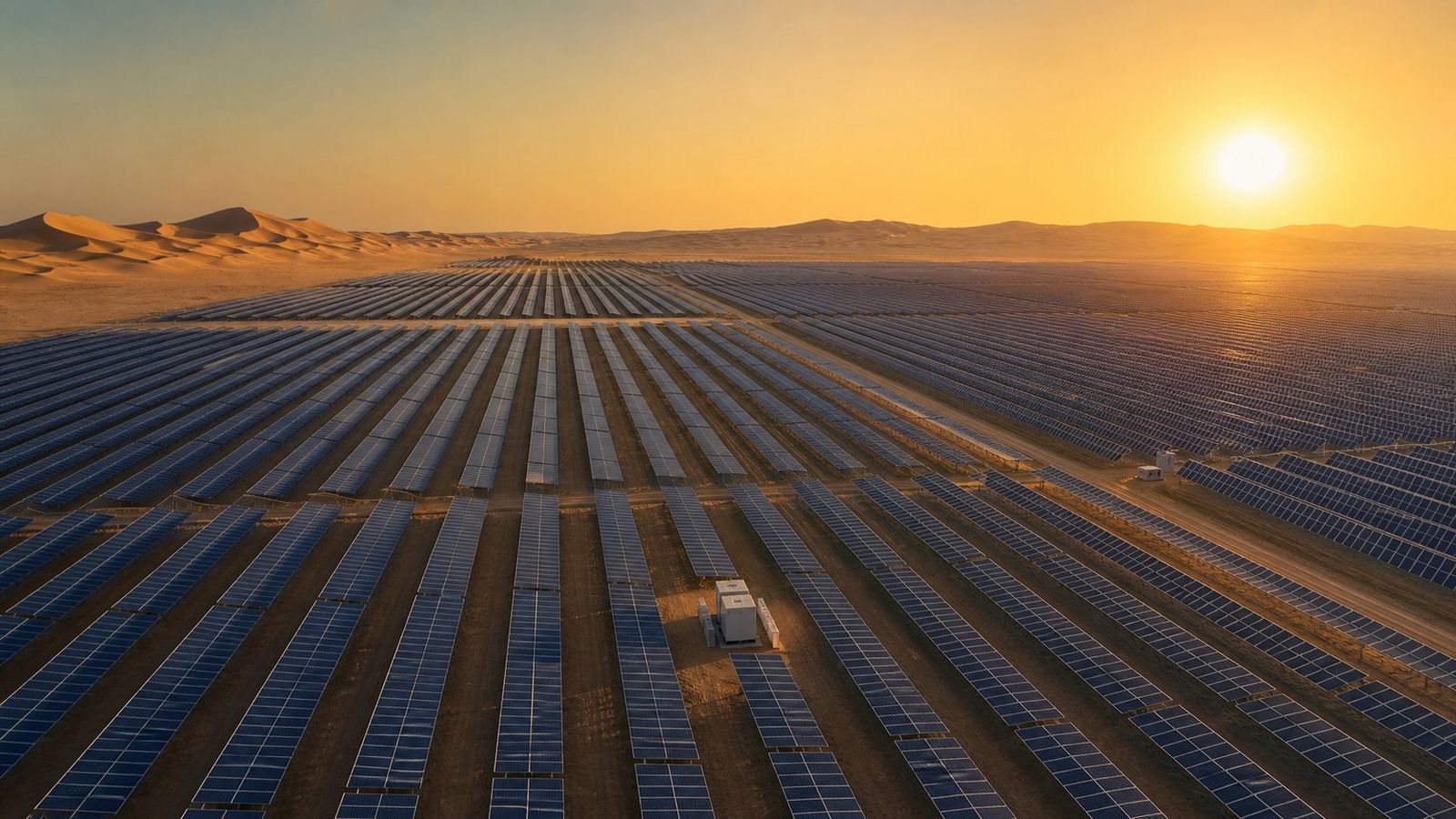
The Kingdom enjoys one of the world's highest solar irradiation levels, exceeding 2,200 kWh per square metre annually in most regions. Combined with vast flat land, this makes Saudi Arabia one of the best locations on earth for competitively priced solar electricity.
How does sunlight become electricity?
Utility-scale plants rely on silicon-based photovoltaic cells, which release electrons when struck by photons, generating direct current (DC). Inverters convert DC to grid-compatible alternating current (AC), and substations step up the voltage for transmission.
Because dust affects panel efficiency, Saudi projects deploy robotic cleaning systems and carefully optimise panel tilt for local latitude.
From Sudair to Al-Shuaibah: landmark projects
- Sudair (1.5 GW): north of Riyadh — among the world's largest single-site plants, with a record tariff of 1.239 US cents/kWh.
- Al-Shuaibah (2.6 GW): south of Jeddah — one of the region's largest projects under development.
- Sakaka (300 MW): the first project of the National Renewable Energy Programme.
- Al-Dawadmi, Bisha, Khulais, Afif: successive competitive auction rounds.
World-record prices
The competitive rounds run by the Renewable Energy Project Development Office (REPDO) have consistently delivered some of the world's lowest solar tariffs, thanks to resource quality and intense competition — accelerating deployment from 12.3 GW in March 2025 toward the 100–130 GW target by 2030.
What does this mean for businesses?
Solar is no longer limited to giant utility plants. Rooftop systems for industrial and commercial facilities are now economically attractive, with meaningful savings on electricity bills and payback within a few years. This is our company's focus: from initial studies to operation and maintenance.